450 Approvals in a Decade What, Precisely, Is Singapore Screening?
At face value, the figure invites scepticism.
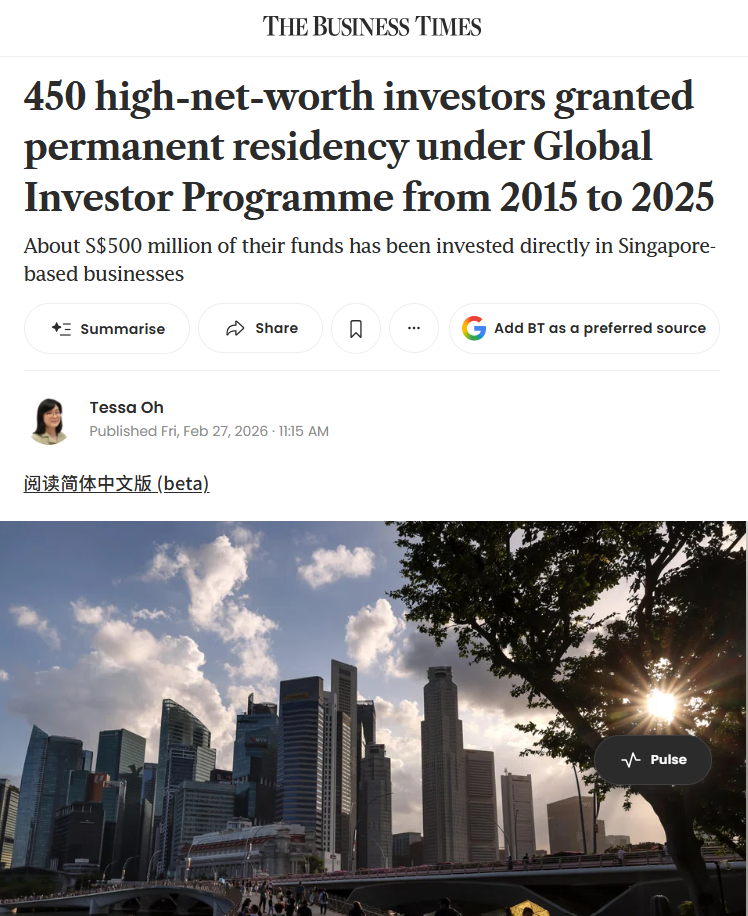
Over the past ten years, approximately 450 investors have obtained Singapore Permanent Residency through the Global Investor Programme (GIP).
In a sector accustomed to four-digit annual approvals, fewer than 50 principal applicants per year appears negligible.
The reaction is predictable.
The interpretation, less so.
The Architecture of Disclosure
Singapore does not publish GIP application volumes, acceptance ratios, or intake statistics. Data surfaces primarily through parliamentary disclosures and centres on approved outcomes.
Between 2015 and 2025, roughly S$500 million was channelled directly into Singapore-based enterprises under GIP. More than half was deployed into professional services, information and communications technology, and financial services. An additional S$30 million entered via designated funds.
The state does not foreground demand.
It foregrounds economic insertion.
That choice of emphasis is not accidental.
The Pandemic Inflection Point
Between 2020 and 2022, global wealth entered a defensive posture. Jurisdictional resilience moved to the forefront of boardroom deliberations. Alternative residency demand accelerated across multiple regions.
Singapore approved approximately 200 GIP applicants during that period.
If expansion had been the operative objective, those years presented optimal conditions.
Approval velocity did not materially increase.
The perimeter held.
Even amid peak global demand, the admission threshold remained intact.
The Upward Revision of Thresholds
In 2023, Singapore elevated capital requirements across all GIP pathways.
Direct investment minima increased.
Fund allocation requirements rose.
Single family office structures were subjected to higher asset bases and more substantive domestic deployment criteria.
Regimes designed to maximise inflow rarely raise barriers during competitive intensity.
Singapore did so.
The implication is unambiguous: inflow volume was not the governing metric.
The Capital Stratification
Comparative thresholds illustrate the divergence.
European residency-by-investment frameworks frequently operate within the €250,000–€500,000 range, often tethered to property acquisition. The US EB-5 programme requires US$800,000 to US$1.05 million.
Singapore’s GIP requires S$10 million in direct enterprise investment, S$25 million into approved funds, or the establishment of a single family office managing at least S$200 million with demonstrable local deployment.
This is not price differentiation. It is capital stratification.
Low-volume approvals at this intensity generate a markedly different economic profile from high-volume regimes elsewhere.
Entry Versus Embedding
There is no passive property channel under GIP. Capital is expected to embed within operating enterprises or structured vehicles aligned with domestic sectoral priorities.
Many jurisdictions facilitate capital entry.
Singapore mandates capital embedding.
The distinction separates fiscal instruments from strategic filters.
Reconsidering the 450
Evaluated through a scale-centric lens, 450 appears insubstantial.
Evaluated through a calibration lens, it appears deliberate.
Permanent Residency in Singapore is not positioned as a transactional lever. It operates as a structural variable within a tightly governed financial ecosystem.
Scarcity, in this framework, reflects supply discipline rather than demand insufficiency.
The pertinent question is not why approvals were limited.
It is whether expansion was ever the intent.
When assessed against its own policy architecture, the figure ceases to be anomalous.
It becomes coherent.