When Sea Lanes Falter, Geography Reprices: Why Turkey Is Moving to the Center of the Eurasian Map
While much of the market continues to debate where oil prices might go, a more consequential shift is already underway—one that has less to do with commodities and more to do with control over routes.
In recent months, a subtle but telling signal has emerged: Turkey is being re-evaluated—not only by logistics planners and manufacturers, but increasingly by globally mobile capital. Even interest in Turkey’s citizenship-by-investment pathway has risen in tandem with geopolitical volatility.
This is not sentiment. It is structure.
From Maritime Efficiency to Strategic Uncertainty
For three decades, globalization was anchored in a simple premise: maritime trade was cheap, predictable, and scalable. The Suez–Red Sea corridor, complemented by the Strait of Hormuz, formed the backbone of Eurasian commerce.
That assumption no longer holds.
Disruptions in the Red Sea have already demonstrated that shipping does not require a formal blockade to reroute—only a shift in risk perception. Cargo flows have diverted, insurance costs have surged, and delivery timelines have stretched. When risk becomes unpriceable, routes become unusable in practice.
The key development in 2026 is not that a single chokepoint is under stress, but that multiple critical corridors are simultaneously less reliable. Northern routes remain geopolitically constrained, southern sea lanes face persistent security risks, and energy transit corridors are under renewed scrutiny.
The result is not a rerouting—it is a repricing of geography.
The Rise of the Middle Corridor
Against this backdrop, the so-called “Middle Corridor”—linking China through Central Asia, across the Caspian, into the Caucasus, and onward through Turkey into Europe—has moved from contingency to strategy.
This shift is not theoretical. European infrastructure policy has already incorporated this corridor into long-term connectivity planning. Multilateral financing is accelerating rail and intermodal upgrades across Turkey’s eastern axis. Freight volumes along the Trans-Caspian route have more than doubled in recent years, albeit from a low base.
What matters is not scale today, but direction.
As maritime reliability declines, even marginal alternatives gain strategic weight. Turkey, as the western terminus of this corridor, is no longer simply a transit state. It is becoming an interface—where Asian production meets European demand under a different risk regime.
When Routes Fragment, Operations Localize
The more profound consequence of this shift is not logistical, but structural.
Companies are not merely changing routes—they are reconfiguring supply chains. European clients are demanding shorter, more predictable delivery cycles. Inventory is moving closer to end markets. Distribution is being regionalized. In some cases, light manufacturing is being relocated to intermediate nodes.
This is where Turkey’s role evolves.
What was once a pass-through geography is becoming a place of operation—warehousing, consolidation, processing, and regional management. As activity concentrates, so too does value. Industrial zones, logistics hubs, and infrastructure-adjacent real estate are being repriced—not as passive assets, but as embedded positions within a reconfigured trade network.
In this context, property is no longer merely property. It is access to flow.
Citizenship as Infrastructure, Not Identity
At this stage, the conversation shifts from logistics to jurisdiction.
Once operations localize, companies face a more practical question: can they reliably operate, control assets, and move capital within these new nodes?
This is where citizenship enters—not as a lifestyle choice, but as an operational tool.
Turkey’s citizenship-by-investment framework—structured around a minimum real estate investment of USD 400,000 with a three-year holding period—offers something distinct in the current environment: a legal foothold within a re-emerging Eurasian interface.
Unlike residency programs that impose physical presence requirements, Turkey’s model provides immediate citizenship without relocation, enabling business continuity while adding a second jurisdictional base. The asset itself—often tied to logistics corridors or urban distribution centers—functions both as an investment and as a claim on future trade flows.
This duality is increasingly relevant.
The Strategic Value of Ambiguity
Turkey’s geopolitical position further amplifies this utility.
As a NATO member with deep economic ties to Europe, yet simultaneously engaged across the Middle East and Central Asia, Turkey occupies a rare “in-between” space. In an era defined by polarization, such ambiguity is not a weakness—it is a form of optionality.
For globally exposed investors, this translates into a buffer against regulatory fragmentation, capital controls, and cross-border friction. A Turkish passport does not replace primary citizenship; it complements it, introducing a second axis of mobility and legal flexibility.
In volatile systems, redundancy is resilience.
Timing the Structural Window
The critical question, then, is not whether this shift is happening—but when to act.
Infrastructure cycles, by definition, are long. The Middle Corridor is still in build-out mode. Capital has begun to position, but has not yet fully repriced underlying assets. Policy frameworks remain relatively accessible.
History suggests that once trade flows stabilize and corridor capacity expands, entry costs—both financial and regulatory—tend to rise.
What we are witnessing today is not the peak of a trend, but its early formation.
Beyond Property, Toward Positioning
In conventional terms, Turkey’s program is framed as a real estate investment leading to citizenship. That framing is increasingly insufficient.
What is being acquired is not merely a property, nor even a passport, but a position within an emerging trade architecture.
As maritime certainty erodes and continental routes gain relevance, the question for globally active individuals and enterprises is no longer simply “where to invest,” but:
Where do you need to be?
In a system where routes can fail, location becomes strategy—and presence becomes power.
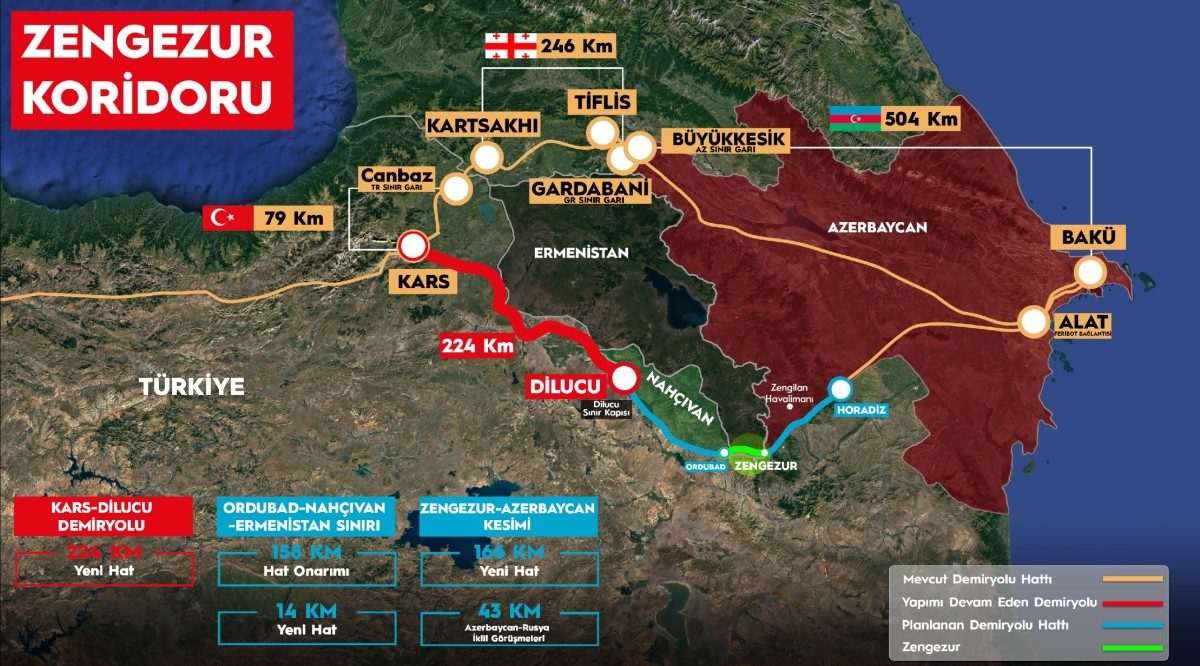
This map reflects one of Turkey’s priority infrastructure projects for 2026—the Zangezur Corridor railway plan.
The red line, a newly built 224-kilometer “Yeni Hat” (New Line), will directly connect Azerbaijan, Nakhchivan, and Kars in eastern Turkey. Once operational, it does more than add another rail segment—it closes a missing link in a contiguous Eurasian land corridor.
In a world where the Suez Canal and the Strait of Hormuz are no longer treated as permanently reliable, this connection effectively elevates Kars from a peripheral city to a strategic inland gateway between Asia and Europe.
From an investment perspective, this is where the logic becomes tangible.
The real estate component tied to Turkey’s citizenship-by-investment program—starting at USD 400,000 with a three-year holding period—can be understood not simply as property ownership, but as exposure to a logistics corridor in formation.
As infrastructure comes online and freight flows stabilize, assets positioned along these nodes tend to reprice—not incrementally, but structurally. By the time the corridor is fully operational, what is being monetized is no longer just real estate, but participation in a functioning trade route.
In that sense, the investment is less about acquiring a passport, and more about securing a position within an emerging Eurasian network—where both the asset and the citizenship become part of the same strategic outcome.