Singapore Has Changed the Rules for Single Family Offices. Both New and Existing SFOs Are Affected.
Singapore has introduced one of the most important reforms to its Single Family Office framework in years.
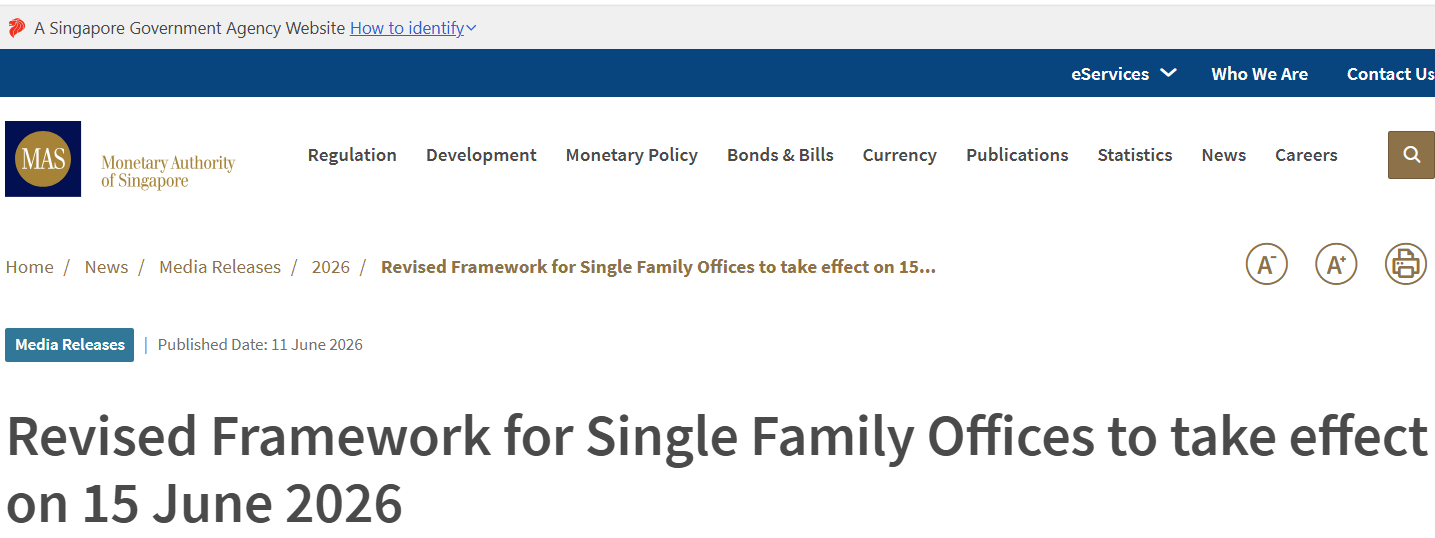
From 15 June 2026, new Single Family Offices must operate under MAS’ new licensing exemption framework. Existing Single Family Offices already operating in Singapore have only one year, until 15 June 2027, to align with the same rules.
This is a major shift for a sector that has grown rapidly. Singapore had about 400 SFOs awarded tax incentives at the end of 2020. By the end of 2024, that number had grown to more than 2,000. A regime built for hundreds of structures is now being redesigned for thousands.
The reform changes the operating logic of Singapore SFOs in five practical ways.
- First, MAS is replacing case-by-case licensing exemptions with a unified statutory exemption framework. The old approach gave flexibility. The new approach gives scale, consistency and clearer supervisory boundaries.
- Second, qualifying SFOs must be incorporated in Singapore. This anchors the structure inside Singapore’s legal system and gives MAS a clearer regulatory point of reference.
- Third, the family definition is now formally codified. The framework recognises lineal descendants, spouses, former spouses, adopted children, stepchildren and in-law relationships, subject to a five-generation boundary. For succession planning, this matters. Family scope is no longer left largely to interpretation.
- Fourth, key employees may participate within limits. Executive directors, CEOs, CFOs and investment professionals may hold a non-controlling stake and contribute assets, capped at 10% in aggregate. This recognises how modern family offices operate: many are no longer passive administrative vehicles, but professional investment platforms.
- Fifth, SFOs must notify MAS, maintain regulated banking relationships and file annual returns covering assets under management and banking arrangements. New SFOs must notify MAS within 14 days of commencement. Annual returns must be filed within four months after the financial year end. Existing SFOs must complete alignment by 15 June 2027.
The question now is whether this is a risky move for Singapore.
In the short term, stricter rules may raise the preparation burden for some families. Lightweight structures, unclear ownership chains, weak source-of-wealth documentation or loosely managed overseas vehicles will face more friction.
In the long term, this is likely a smart move.
Global wealth centres are competing in a more difficult environment. Hong Kong is rebuilding its family office position. Dubai is moving aggressively to attract capital and wealthy migrants. Switzerland remains strong in legacy private banking. Luxembourg remains central to institutional fund structures.
Singapore’s advantage cannot rely only on tax efficiency or ease of setup. The next competition is about credibility: which jurisdiction gives families access to global banking, regulatory trust, investment flexibility, political stability and long-term succession certainty.
That is where this reform becomes important.
MAS is not closing the door to family offices. It is raising the quality of who can enter and how they must operate. For serious families, this creates a stronger jurisdiction. A Singapore SFO that is properly structured, clearly owned, bankable and compliant will be easier to defend in front of banks, regulators, counterparties and future generations.
For families planning to establish a Singapore SFO, the message is clear: do not treat the SFO as a simple company setup. The structure should be designed from day one around family ownership, control, source of wealth, banking readiness, investment strategy, 13O or 13U tax planning, possible GIP considerations and long-term residency or succession objectives.
The families best positioned under the new framework will be those with genuine wealth, clear documentation, long-term commitment to Singapore and a willingness to build real governance.
For existing Singapore SFOs, the message is more urgent.
The one-year transition period is already running. Existing structures should be reviewed against the new requirements on Singapore incorporation, family ownership, family control, key employee participation, fund vehicle banking, MAS notification and annual reporting.
15 June 2027 may look distant, but restructuring ownership, updating documentation, aligning bank accounts and preparing compliance records can take time.
Singapore’s SFO future remains strong. The rules have changed because the market has matured.
For families who are prepared, this reform should increase confidence in Singapore — not reduce it.
At Adepture, we see this as a strategic checkpoint for both new and existing Single Family Offices. The right question now is simple: is your structure ready for the next phase of Singapore’s family office regime?