China’s New Cross-Border E-Commerce Push Is Bigger Than E-Commerce — And Singapore May Be One of Its Biggest Winners
China’s latest measures to support cross-border e-commerce have largely been interpreted as another attempt to boost exports.
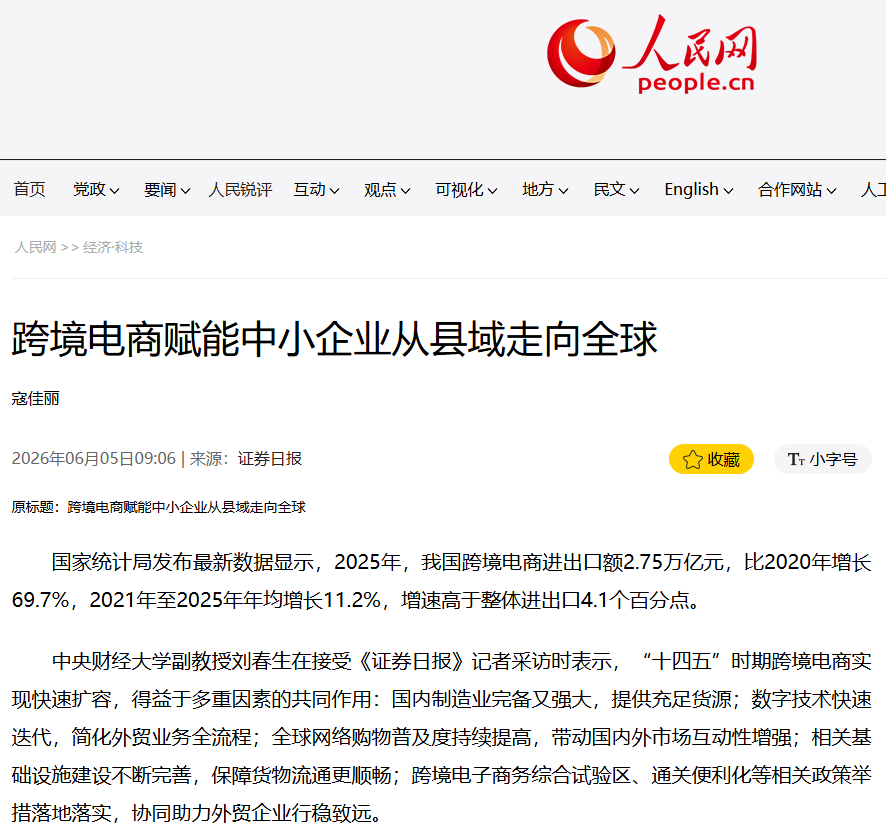
Source: People’s Daily Online (China)
That interpretation is understandable—but incomplete.
Behind the policy lies a much broader strategic shift. Beijing is no longer simply encouraging Chinese companies to sell more products overseas. It is encouraging them to build the capabilities needed to operate globally: developing international brands, establishing overseas warehouses, expanding digital trade, strengthening global supply chains and building long-term commercial operations beyond China’s borders.
That distinction matters because it changes what China is exporting.
For decades, China’s success was built on exporting products. The next phase of its globalisation appears increasingly focused on exporting enterprises.
From Exporting Products to Building Global Businesses
Selling products overseas and operating a global business are fundamentally different.
A company that exports products mainly needs customers and distribution channels. A company that operates internationally requires something far more sophisticated. It needs regional management, international banking, legal and tax expertise, intellectual property protection, cross-border talent, treasury management and trusted commercial partners.
In other words, once Chinese companies move beyond exporting products, they begin exporting business functions.
And business functions need somewhere to operate.
That is where this policy becomes relevant far beyond China itself.
Why Singapore Is Uniquely Positioned
This is precisely where Singapore enters the story.
Singapore has never competed with China as a manufacturing centre. Instead, it has spent decades positioning itself as Asia’s international business hub—an ecosystem built around finance, legal certainty, corporate governance, connectivity and regional management.
Those strengths are becoming increasingly valuable because they match exactly what internationally operating companies need.
As more Chinese enterprises establish overseas operations, they will require places to coordinate regional business, manage international contracts, oversee treasury functions, recruit regional leadership, protect intellectual property and expand into new markets.
Singapore was built for precisely these functions.
The Opportunity Extends Far Beyond Trade
The implications therefore extend well beyond exports.
Every Chinese company that evolves from an exporter into a multinational enterprise creates demand for an entirely different business ecosystem. Banking shifts from simple trade settlement to treasury management and cross-border financing. Legal and accounting firms become partners in structuring international operations and navigating multiple regulatory environments. Executive search firms help build regional leadership teams, while technology providers support increasingly complex digital operations across markets. As founders and senior executives spend more time managing international businesses, demand also grows for wealth management, international education, commercial real estate and other high-value professional services.
The opportunity, therefore, is not confined to logistics or trade.
It extends across much of Singapore’s knowledge economy.
A New Division of Labour in Asia
Perhaps the most important implication is what this means for the future structure of Asia’s economy.
Much of the discussion surrounding China has centred on supply-chain relocation. Yet the more likely outcome is not that manufacturing leaves China, but that business functions become increasingly international.
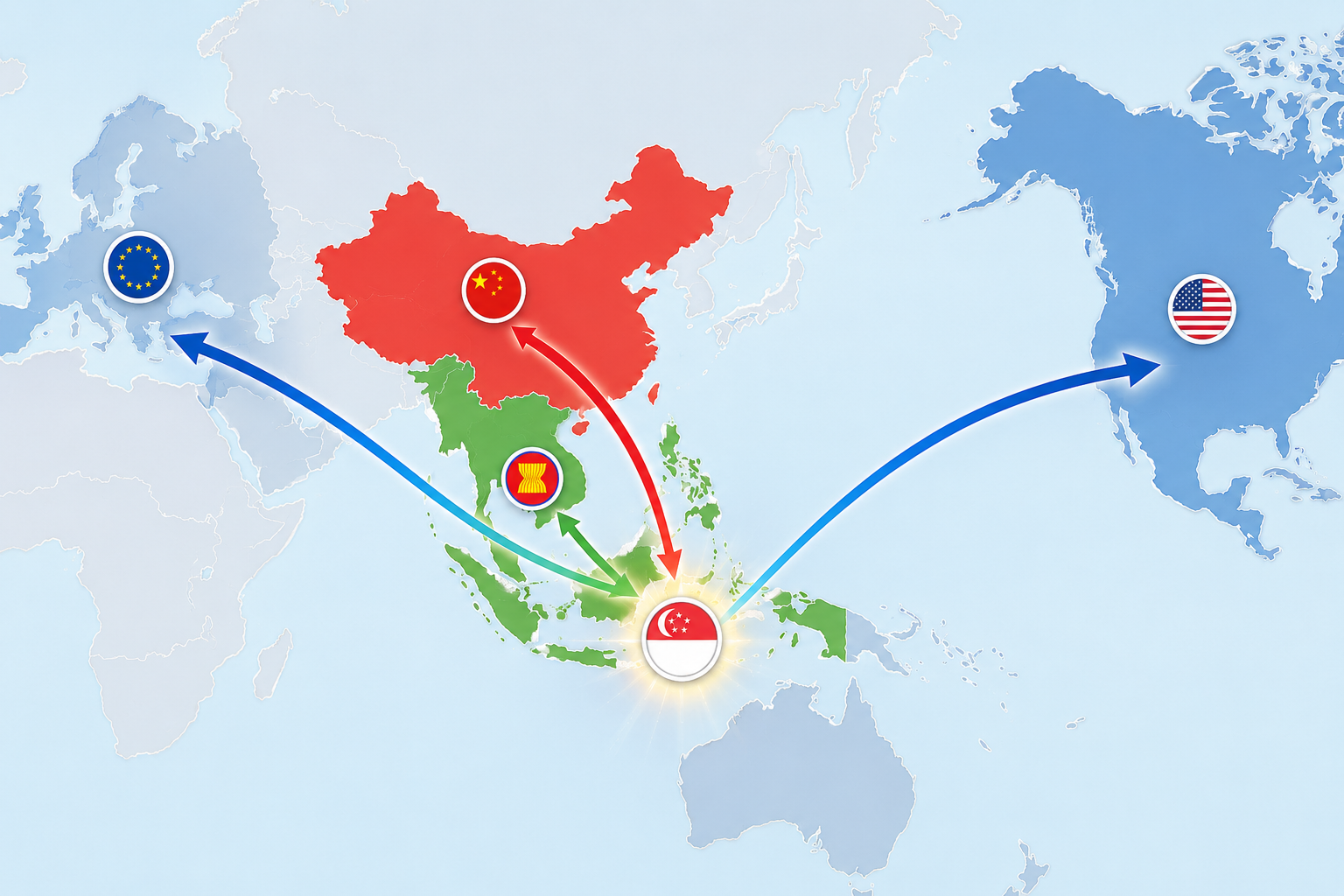
China is expected to remain one of the world’s most important manufacturing, research and supply-chain centres. ASEAN will continue to be one of the fastest-growing consumer markets globally. Increasingly, Singapore is positioned to become the platform where Chinese companies coordinate regional operations, manage international partnerships, build global brands and connect with international capital.
Rather than replacing one another, the three play different but complementary roles.
China creates.
Singapore coordinates.
ASEAN grows.
A Policy That May Reshape More Than Trade
Policies rarely transform economies overnight.
What they do is reveal the direction governments want businesses to move.
China’s latest policy suggests that the country’s next stage of globalisation will no longer be measured solely by export volumes, but by the number of Chinese companies capable of operating successfully across multiple markets.
That shift carries important implications for Singapore.
The opportunity is not simply more trade, nor merely more company incorporations. It is the potential to become one of the principal platforms through which Chinese enterprises organise their international operations, manage regional growth and build long-term global businesses.
The next chapter of China’s globalisation may not be defined by how many products leave its ports.
It may be defined by how many Chinese companies choose to build their international future beyond China’s borders—and Singapore is uniquely positioned to become one of the places where that future takes shape.